
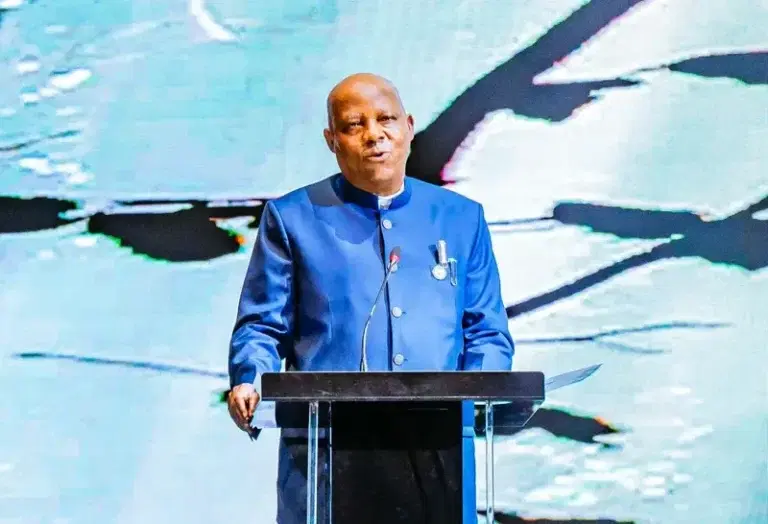
Vice President Kashim Shettima says Nigeria is deploying Artificial Intelligence (AI) and other modern technologies to monitor food production, enhance transparency, connect producers to markets, and reduce waste across the agricultural value chain.
Shettima said this at the opening session of the United Nations Food Systems Summit Stocktake (UNFSS+4), in Addis Ababa, on Monday.
The summit will build on the momentum of the 2021 UN Food Systems Summit and the first Stocktake in 2023 (UNFSS+2), focusing on accelerating sustainable, inclusive, and resilient food systems transformation.
The event will spotlight successful country-level transformations, highlight innovative practices, and address challenges faced in fragile and conflict-affected settings.
The vice-president said that food and nutrition were now central pillars of both the National Development Plan 2021 to 2025 and the Nigeria Agenda 2050.
He stated that food insecurity was no longer a shadow lurking in distant lands, adding, “It is a shared affliction; whether you live by the banks of the Niger or the banks of the Tiber, you will find the same truth.
Shettima said, “The Fourth Industrial Revolution has not only disrupted the old order but also gifted us instruments that were once confined to the imagination.
”Artificial intelligence, geospatial analytics, and satellite-driven climate intelligence are now part of our agricultural vocabulary.
”We are deploying these tools to monitor production, enhance transparency, connect producers to markets, and reduce waste across the value chain.
”Our faith in the capacity of our people remains unshaken. In partnership with the African Development Bank and IFAD, we are investing in Special Agro-Industrial Processing Zones.
”These hubs are not just places of production. They are engines of transformation.”
He said that they were creating jobs, attracting private capital, and linking rural producers to national and global markets.
The vice-president added, ”But production is not enough. We believe that a sustainable food system must also be a healthy one.”
Shettima said that Nigeria had scaled up investments in school feeding programmes, nutrition-sensitive agriculture, and community-driven nutrition education.
According to him, through the Nutrition 774 initiative, the government is placing all of Nigeria’s 774 local governments at the centre of nutrition delivery.
He said, ”In doing so, we are making the Sustainable Development Goals local. We are transforming pledges into meals.”
Shettima disclosed that the Federal Executive Council (FEC) had approved the National Multi-Sectoral Plan of Action for Food and Nutrition to serve as the implementation arm of the revised national food and nutrition policy.
He added that government had directed the establishment of nutrition departments in relevant ministries.
According to him, these are the building blocks of institutional reform and the architecture of nutrition governance.
Shettima said, ”This is more than a summit. This is a reckoning. The world is changing before our eyes.
“The scars of conflict, the uncertainties of climate, the distortions of markets, and the missteps in policy are all calling us to renew our commitment to multilateralism.
”We must act, and we must act together. We are under no illusions.
“The road ahead is long and lined with complexities. But we are not paralysed by fear.
”We understand that the world we desire will not emerge from declarations alone.
According to him, it must be built with patience and persistence, with bold ideas and careful planning, and with shared resolve and shared responsibility.
Shettima assured that Nigeria was ready to listen, learn, and lead wherever leadership is required.
He added, ”We are here to champion food systems that are resilient in the face of climate shocks, responsive to nutritional needs, and rooted in local realities.
”We are here because we believe that the arc of history does not only bend towards justice. It bends towards food justice.
”Let us leave Addis Ababa not with diplomatic pleasantries but with a conviction.
“A broken food system in any part of the world diminishes the dignity of humanity as a whole.
”Let us rise with a shared purpose. Let us build a world where no child sleeps on an empty stomach, where no farmer is forgotten, and where food is not a luxury but a human right.”
The Prime Minister of Ethiopia, Dr. Abiy Ahmed, said the event was a moment to take stock and to renew shared commitment to building food systems that are resilient, inclusive, and just.
Ahmed said that Africa needs predictable concession finance to invest in agriculture, rural transformation, infrastructure, and literacy.
He stated that climate finance must be aligned with food systems because hunger and environmental degradation are deeply linked.
According to him, since the first food system summit in 2021, Ethiopia has launched a comprehensive roadmap for food system transformation.
He added, ”Four years ago, we came together to pursue a bold vision of food systems that are sustainable, equitable, and resilient.
“But it is not only about agriculture; it shapes our health, our economy, our environment, and our future.
”Today we reflect on the progress made and recommit to urgent coordinated action.
”Globally, food systems are facing immense pressure from planning stock, shocks, conflicts, inequalities, and economic destruction.
”At the same time, development assistance is declined in multilateral cooperation.”
According to Ahmed, these challenges had threatened production, supply, and dignity in the subregion nations.
He added, ”Yet in this context the human spirit and our shared resolve to act remain strong.
“In Ethiopia we have made a deliberate choice to act boldly, to think holistically, and to place human dignity at the centre of our food system transformation.
”We are investing in local production, reducing dependency on imports, and building a resilience system that serves our people and our future.”
The Secretary-General of the United Nations, António Guterres, who spoke in a recorded video, said that food systems were about more than food, adding, “They include climate, justice, and the right to a better future.
”Since the last food summit we have seen progress.
“We committed to food systems that are inclusive, sustainable, equitable, resilient, and built on human rights, but progress is not fair enough.
”Global hunger is rising; threats and shocks are pushing up the prices of food.
”The Gross Domestic Product (GDP) of the African continent is not just a crisis of scarcity; it is a crisis of justice, equity, and climate.”
According to the UN scribe, climate change is destroying harvests, supply chains, and humanitarian response,” he said.
Others who spoke were the Prime Minister of Italy, Giorgia Meloni, and Kenyan President William Ruto, among other heads of state and representatives from multilateral organisations. (NAN)
Comments
Post a Comment