
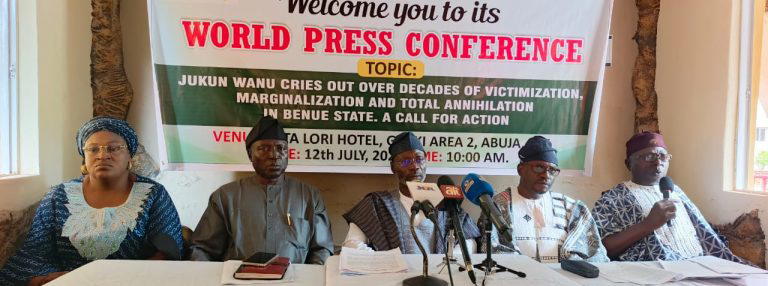
The National Association of Jukun Wanu (NAJUWA), the umbrella body of the Jukun Wanu people in Nigeria and the diaspora, has raised concerns over what it described as persistent oppression and marginalisation of its people in Benue State. The group is calling on President Bola Tinubu to intervene and ensure justice, equity, and inclusion.
At a world press conference held in Abuja on Saturday, with the theme “Defending Our Heritage, Seeking Justice, and Upholding Truth Amidst Misrepresentation and Historical Injustice,” NAJUWA emphasized the need for recognition of the rights and status of the Jukun-Wanu people in the socio-political and economic structure of both Benue State and Nigeria.
NAJUWA President, Elder Moses Adanwo Amankye, who read the text of the conference, said despite being the original inhabitants of lands now comprising 14 local government areas in Benue, the Jukun-Wanu have faced decades of marginalisation, exclusion, and mistreatment.
“Our hearts are heavy with sorrow over the injustices we continue to face,” he said. “But we remain resolute in our commitment to peace, justice, and truth. The time has come for justice, inclusion, and equity for the Jukun-Wanu people.”
Amankye described the Jukun-Wanu as riverine descendants of the historic Kwararafa Empire with a rich heritage of peaceful coexistence across Benue, Nasarawa, Taraba, and Adamawa States. In Benue alone, he said, Jukun-Wanu communities exist in over 21 locations across Makurdi, Guma, and Logo LGAs.
He lamented that despite their deep-rooted presence, the people have suffered dispossession, misrepresentation, and systematic neglect, including the absence of government infrastructure such as schools, hospitals, roads, and clean water. He also decried the lack of recognition for Jukun-Wanu traditional stools under state law, interference in chieftaincy affairs, and the exclusion of Jukun-Wanu people from state civil service and political representation.
“There is consistent interference in our traditional chieftaincy affairs, undermining our heritage and leadership structures,” he said. “Our people are threatened and intimidated, our lands encroached upon, and we are denied a local government area that reflects our population and historical relevance. Politically, we are disenfranchised.”
Amankye further condemned the spread of misinformation and hate speech on social media, which he said has resulted in incitement, violence, and damage to lives and property.
“These false and inciting narratives, including allegations of collaboration with violent actors, are not only baseless but dangerous,” he said. “We have taken steps to report these issues to the Benue State Police Command, the Department of State Services (DSS), and the Nigeria Security and Civil Defence Corps (NSCDC).”
He cited the Justice Oki Commission Report of 1995 and the Commassie Commission Report of 2003 as historical evidence confirming the Jukun-Wanu’s indigenous status in Benue. Despite this, he said, state policies continue to violate their constitutional rights.
NAJUWA called on the Federal Government, Benue State Government, and the international community to take urgent steps to address the plight of the Jukun-Wanu people.
Specifically, the group urged President Bola Ahmed Tinubu to direct the Benue State Government to review and amend the Benue State Traditional Council and Chieftaincy Laws of 2016 to officially recognise Jukun-Wanu traditional institutions.
They also demanded the reinstatement and recognition of the Jukun-Wanu chiefdoms in Abinsi and Agyogo (Wurkum Makurdi), as documented in 1934, the grading of their traditional stools, and government presence in their communities.
“The time is now to act,” Amankye declared. “We seek not domination but recognition, inclusion, and justice.”
Comments
Post a Comment