
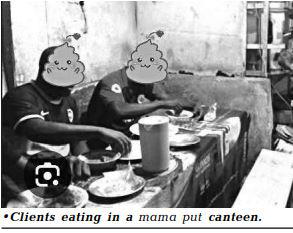
Workers in the Federal Capital Territory (FCT) are increasingly patronising ‘Mama put’ restaurants as rising food prices make meals at conventional eateries less affordable.
Some workers and residents in parts of Abuja, who spoke in separate interviews with the News Agency of Nigeria (NAN) on Monday, said they patronised local food vendors, especially during lunch breaks.
According to them, mama put is more affordable than conventional restaurants, adding that they can get basic meals such as rice, beans, amala, eba, starch, yam and assorted soup cheaper from the open-air vendors.
They said amid the increasing cost of living, the informal roadside restaurants, which serve locally prepared meals at relatively affordable prices, have become an alternative for workers seeking quick meals.
According to them, affordability, convenience and proximity to their workplaces influence their decisions to patronise local food vendors.
Umar Musa, a civil servant in the Central Business District, said eating at a nearby local restaurant helped him save time and transportation costs.
“Coming to this place is much easier for me. There is no transportation cost because it is close to my workplace, and it helps me eat quickly and return to work,” he said.
Another civil servant, Halima Abubakar, said convenience and affordability were among the reasons she occasionally ate at local restaurants.
She, however, noted that preparing meals at home remained a cheaper option.
“Sometimes, I eat at restaurants because it saves me the stress of cooking, but I do so occasionally because eating at home is more affordable,” she said.
For some customers, the taste, quality and quantity of meals were equally important considerations.
Jumai Ajuma, a customer at Area 10, said the restaurant offered meals within her budget, adding that some conventional eateries charged more without necessarily providing better food.
“Sometimes, I spend more at conventional eateries and still do not get the good taste, quantity and quality,” she said.
Also, Hamza Abdullahi, a taxi driver in Gwarimpa, said patronising local restaurants had become part of his routine, particularly on working days.
“The nature of my job will not allow me to drive home to eat and then drive out to continue working.
“Instead, I come here to my favourite restaurant, where I can eat affordable starch and banga soup,” he said.
David Emmanuel, a member of the National Youth Service Corps (NYSC), said local food outlets helped him manage his daily expenses amid the rising cost of transportation and other necessities.
“As a corps member, I have to plan my money properly, especially with the high cost of transportation and other things.
“Eating at a Mama Put restaurant helps me to save money because I can get a good meal without spending too much,” he said.
Similarly, Patience Okafor, a businesswoman at Wuse Market, said the availability of different local dishes was one of the reasons she patronised the restaurants.
“I like coming here because I can choose from different types of food and the prices are still manageable.
“Sometimes, I do not have the time to cook at home, so coming here saves me time and gives me the opportunity to eat a proper meal,” she said.
Some operators of Mama also spoke with NAN, saying that although there was steady patronage, the high cost of food items was affecting their businesses.
At the Central Business District, a food vendor, Miracle Uche, who operates Mama Destiny Restaurant, said public workers constituted a significant proportion of her customers.
She said business was progressing in spite of the rising cost of food items, adding that government intervention was needed to address the economic challenges.
“Business is progressing, but the government should intervene in the economy so that prices of items in the market can reduce and become affordable.
“Because of the large number of customers and patronage, I have four female employees working with me,” she said.
Similarly, Esther Chinedu, a food vendor at Area 10, said workers continued to patronise her restaurant because of the affordability and quantity of meals served.
“The cost of food items is high, but we try our best to make the food affordable because most of our customers are workers who have limited time and money during working hours.
“Many customers also come because they know they can get a good portion of food without spending too much,” she said.
Also, Blessing Okoro, who operates a local restaurant at Wuse Market, said the business had provided a means of livelihood for her and her two female employees.
“The business is helping me and my two female workers to survive because people come here every day to eat, and I need more helping hands.
“Sometimes, customers complain about the prices, but we explain to them that the cost of rice, beans, meat and other ingredients has also increased,” she said.
Another vendor, Glory Ekanem, who operates Cali’s Kitchen in Gwarimpa, said the rising cost of food ingredients had affected meal prices, but she remained committed to keeping them affordable.
According to Ekanem, her priority is to retain customers by offering meals at prices they can afford.
“Most restaurants are after making profit, but I am more concerned about customers being able to return next time.
“If a plate of food costs N1, 200 elsewhere, I normally remove N200 from my food prices to manage and keep meals affordable,” she said.
NAN reports that Mama’s restaurants remain an important part of Nigeria’s informal food economy, providing affordable meals for people.
They serve as a vital routine for everyday workers, artisans, and travellers, built on daily repeat customers and traditional cooking methods like firewood.
The businesses also provide livelihoods for food vendors, cooks, servers and other workers involved in food preparation and sales.
However, maintaining proper hygiene and sanitary conditions in food preparation, storage and serving remains essential to ensuring that affordable meals are also safe for consumption. (NAN)
Comments
Post a Comment