
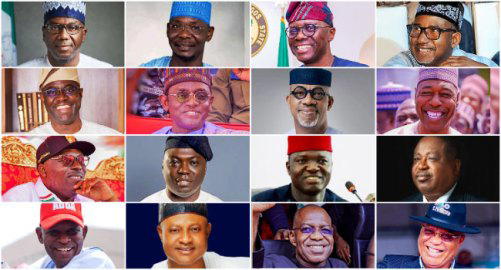
Socio-Economic Rights and Accountability Project (SERAP) has sent Freedom of Information (FOI) requests to Nigeria’s 36 state governors urging them to “promptly account for the spending of public funds in the name of ‘security votes’ by your states since 29 May 2023 to guarantee and ensure the security of life and property of Nigerians resident in your states.”
SERAP also urged the governors to “urgently invite the Economic and Financial Crimes Commission (EFCC) and the Independent Corrupt Practices and Other Related Offences Commission (ICPC) to jointly investigate, track and monitor the spending of security votes by your states.”
In the FoI requests dated 28 June 2025 and signed by SERAP deputy director Kolawole Oluwadare, the organisation said: “In the wake of the Benue massacre and well-documented ongoing cases of insecurity in several states, there is a legitimate public interest for governors to account for how they spend security votes.’”
SERAP said, “the escalating insecurity in several states is taking a devastating toll on socially and economically vulnerable Nigerians, driving up extreme poverty, intensifying hunger and leading to other grave human rights violations.”
According to SERAP, “The framers of the Nigerian Constitution 1999 [as amended] never contemplated opaque spending of public funds as security votes.”
The FoI requests read in part: “Despite the billions of naira yearly budgeted as security votes, many governors are grossly failing to guarantee and ensure the security and welfare of the people in their states, contrary to section 14(2)(b) of the Nigerian Constitution.”
“The obligations of state governors to guarantee and ensure the security and welfare of the Nigerian people is interlinked with their responsibility under section 15(5) of the Nigerian Constitution to ‘abolish all corrupt practices and abuse of office’.”
“The Nigerian Constitution imposes a fundamental obligation on governors to account for and explain to Nigerians how they spend security votes.”
“In 2021 alone, state governors and local government chairmen in the 36 states reportedly collected over N375 billion from the public treasury in the name of security votes.”
“Nigerians have the right to know how your state is spending the public funds budgeted as security votes to guarantee and ensure the security of life and property of Nigerians resident in your state.”
“While SERAP understands that authorities may keep certain matters of operational secrets from the people in the name of national security, there is no constitutional or legal basis to hide basic information on public spending from the people.”
“We would be grateful if the recommended measures are taken within 7 days of the receipt and/or publication of this letter. If we have not heard from you by then, SERAP shall consider appropriate legal actions to compel your state to comply with our requests in the public interest.”
“SERAP notes that the Supreme Court in a groundbreaking judgment declared that the Freedom of Information Act ‘is applicable and applies to the public records in the Federation’, including those kept by your state.”
“With the landmark judgment, the Supreme Court has made clear that state governors can no longer hide under their unfounded claim that the Freedom of Information Act does not apply to them.”
“As the Supreme Court has eloquently stated, any freedom of information law by the state is subject to the Freedom of Information Act.”
“Any failure to account for the spending of security votes by your state will amount to a blatant disregard of the Supreme Court judgment which has effectively ended the claims by governors that the Freedom of Information Act does not apply to how they spend public funds including security votes.”
“The judgment sends a powerful message that state governors can no longer escape accountability for how they spend security votes. SERAP urges you to promptly uphold the judgment by accounting for how your state is spending security votes.”
“The Supreme Court has pointed the way for governors to show transparency and accountability in the spending of security votes.”
“Disclosing details of spending public funds as security votes by your state would serve to engage the Nigerian people in an honest conversation about the security problems in several states and what the governors are doing to respond to them.”
“The intense secrecy and lack of meaningful oversight of the spending of security votes by governors have for many years contributed to large-scale stealing of public funds.”
“Years of secrecy in the spending of security votes have also limited the ability of the people to hold high-ranking public officials to account for their constitutional responsibility to ensure the security and welfare of the people.”
“The failure by state governors to disclose and account for the spending of security votes is a grave violation of the public trust and the provisions of the Nigerian Constitution, national anticorruption laws, and the country’s international human rights and anticorruption obligations.”
“Pervasive tendency by governors to regard or treat security votes as their personal entitlement or funds is antithetical to the Nigerian Constitution and international standards. Security votes should be used for improving the security situation in the states or returned to the public treasury.”
“Section 14(2)(b) of the Nigerian Constitution provides that ‘the security and welfare of the people shall be the primary purpose of government.’ Section 15(5) of the Nigerian Constitution requires your state to abolish all corrupt practices and abuse of power.”
“Section 13 of the Nigerian Constitution further imposes clear responsibility on your state to conform to, observe and apply the provisions of Chapter 2 of the constitution.”
“The public interest in publishing the information sought outweighs any considerations to withhold the information.”
“According to our information, the World Bank last week classified Nigeria as ‘economy in fragile and conflict-affected situations (FCS)’, which explains why the country continues to face severe and persistent development challenges.”
“Other 38 countries classified as FCS alongside Nigeria include Afghanistan, Burkina Faso, Cameroon, Ethiopia, Libya, Mali, and Sudan. The World Bank noted that insecurity is contributing to extreme poverty in Nigeria.”
“According to the Bank, ‘the outlook for poverty in Nigeria is sobering. Millions of people are currently experiencing acute food insecurity. Severe gaps in education and health undermine human development in the country.’”
“Weak state capacity, insecurity, and conflict-related disruptions contribute to poor outcomes across basic services. Insecurity is escalating and inflicting grave economic damage while contributing to violations of human rights across several states.”
“Several state governors continue to fail to effectively discharge their primary and constitutional responsibility to protect the lives and property of the Nigerian people.”
Comments
Post a Comment